Website Maintenance Checklist: 12 Tasks to Do Every Month
Most websites don't fail on launch day. They fail quietly, months later: a plugin update nobody installed, an SSL certificate that expired over…
Read article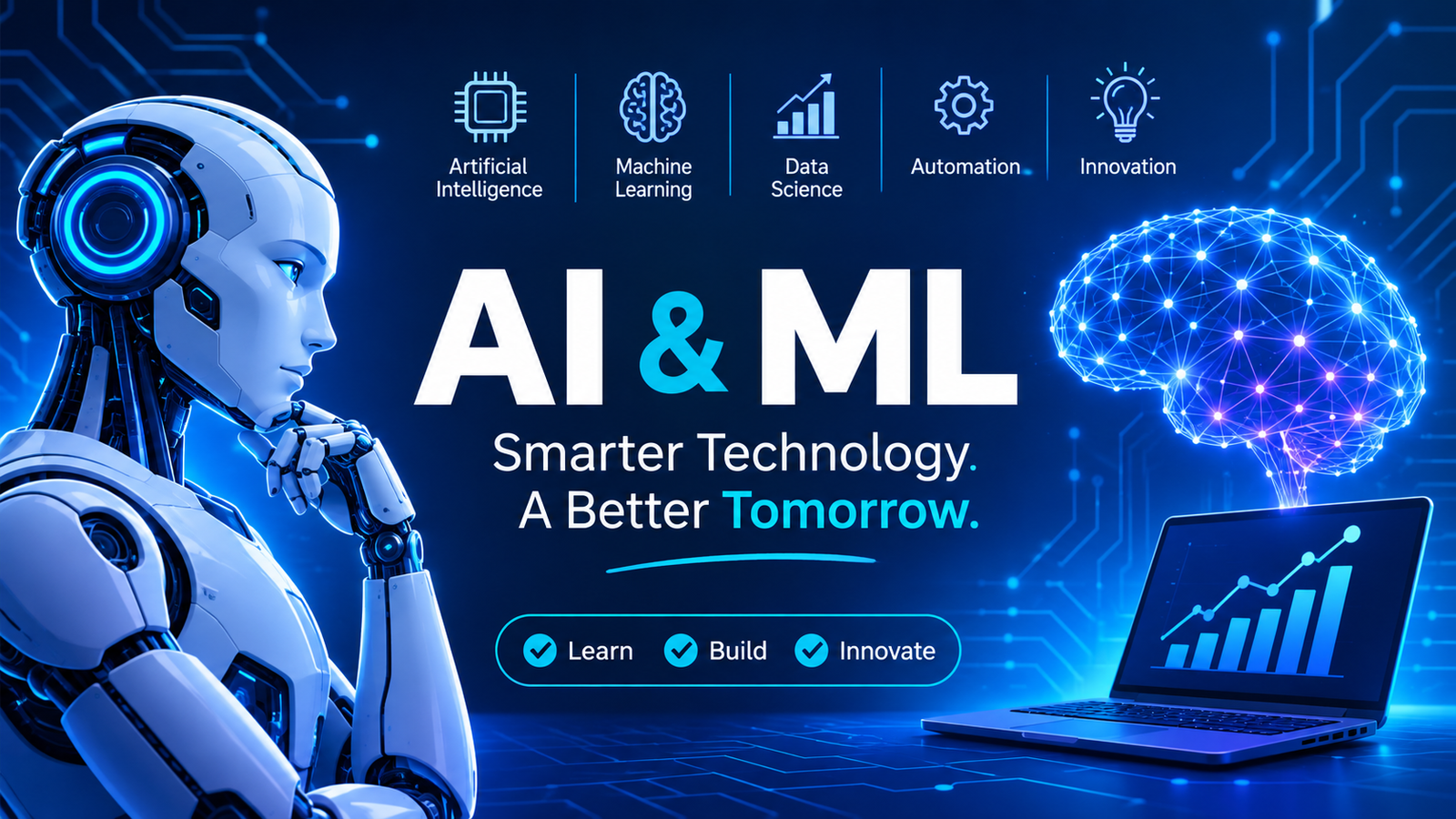
Discover Artificial Intelligence and Machine Learning, their differences, applications, benefits, popular technologies and future career opportunities.
Artificial Intelligence (AI) and Machine Learning (ML) are among the most influential technologies shaping the modern world. From personalized recommendations and virtual assistants to healthcare diagnostics and business automation, AI and ML are transforming how people live, work and interact with technology.
As businesses increasingly adopt digital solutions, understanding AI and ML has become essential for students, professionals, entrepreneurs and organizations.
Artificial Intelligence is a branch of computer science that focuses on developing machines and software capable of performing tasks that typically require human intelligence.
These tasks include:
Examples of AI applications include ChatGPT, virtual assistants, facial recognition systems, recommendation engines and intelligent customer support chatbots.
Machine Learning is a subset of Artificial Intelligence that enables computers to learn patterns from data and improve their performance without being explicitly programmed for every task.
Instead of following only predefined instructions, machine learning algorithms analyze datasets, identify patterns and use those patterns to make predictions or decisions.
For example, an email spam filter learns to identify suspicious messages based on previously analyzed emails.
Although AI and ML are closely connected, they are not the same.
Artificial IntelligenceMachine LearningBroad field of intelligent computingSubfield of AIFocuses on intelligent behaviorFocuses on learning from dataIncludes reasoning and problem-solvingUses algorithms and statistical modelsCan include rule-based systemsLearns patterns from training data
In simple terms, AI is the broader concept of creating intelligent systems, while ML is one of the techniques used to achieve intelligence.
Machine Learning is generally divided into three major categories.
Supervised learning uses labeled datasets to train algorithms.
Examples:
Unsupervised learning identifies hidden patterns in datasets without predefined labels.
Examples:
Reinforcement learning involves training an intelligent system through rewards and penalties based on its actions.
Examples:
AI and ML are being used across multiple industries.
Some important technologies and frameworks used in AI and ML development include:
Businesses can use AI and ML to improve productivity, reduce repetitive work and make better decisions.
Major benefits include:
The future of AI and ML is expected to bring further advancements in robotics, generative AI, autonomous systems, healthcare technology, cybersecurity and intelligent business applications.
Organizations will increasingly explore AI-powered software, intelligent automation and data-driven decision-making.
At the same time, responsible AI development, data privacy, transparency and human oversight will remain important.
If you want to build a career in Artificial Intelligence and Machine Learning, consider following these steps:
Artificial Intelligence and Machine Learning are changing the way businesses operate and how technology is developed. Their applications extend across healthcare, education, finance, manufacturing, retail and many other industries.
Whether you are a student starting your technology journey or a business owner exploring digital transformation, learning about AI and ML can open new opportunities.
The future belongs to intelligent, data-driven and innovative solutions. Understanding AI and ML today is an important step toward participating in that future.
Our team can help you plan, build and grow – book a free consultation today.
Get in touchMost websites don't fail on launch day. They fail quietly, months later: a plugin update nobody installed, an SSL certificate that expired over…
Read articleLearn how MVP development helps startups validate ideas, reduce initial development costs, and launch software products faster. Discover the…
Read articleScope ruthlessly, ship weekly and measure everything. Here is the exact sprint plan we use to take an idea to a working product in two months.
Read article